Why This Matters
Before the techniques, it’s worth understanding what’s at stake. Prolonged loneliness in later life is not simply a matter of mood: research links chronic social isolation to accelerated cognitive decline, worsening chronic illness and a significant drop in quality of life. In Israel, loneliness has been formally adopted as a national indicator within the government’s Optimal Aging framework, developed together with JDC-Eshel, the Myers-JDC-Brookdale Institute and the Central Bureau of Statistics. A regular social framework is one of the strongest protective factors there is.
In other words: the effort to get your parent out of the house isn’t a luxury or a kindness. It’s part of caring for their health.
What Actually Happens at a Social Club?
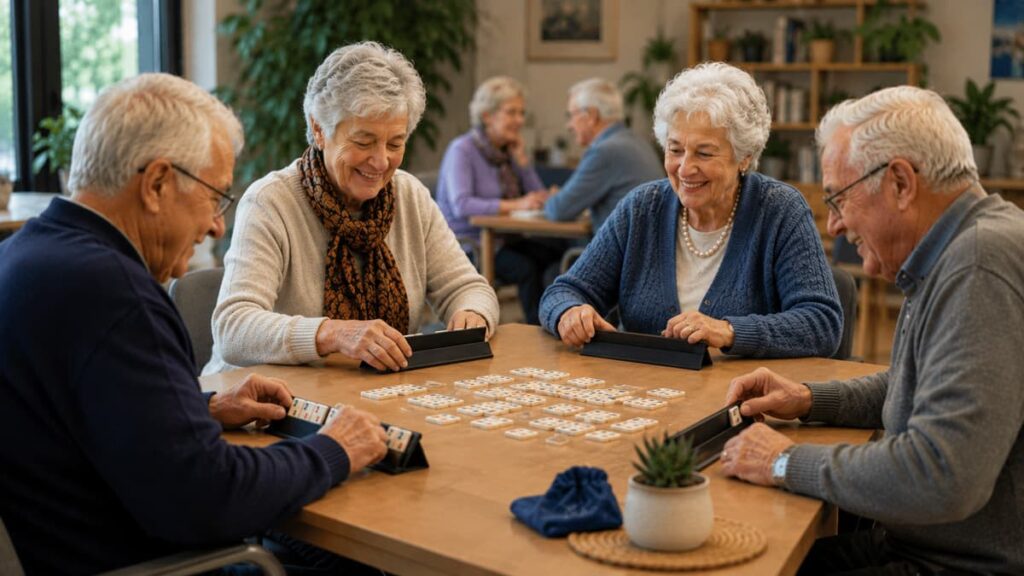
This is the first question your parent will ask, and you should have an answer ready. A social club is not a waiting room. A typical day includes:
- Classes and workshops — art, ceramics, painting, movement, adapted exercise
- Lectures and enrichment — culture, current affairs, history, health
- Social activity — coffee mornings, birthdays, outings and events
- Technology sessions — computer and smartphone workshops, which for many people are the easiest way in
- Volunteering and giving back — a place to be needed, not just to pass the time
The more concretely you can describe it (“there’s a ceramics workshop on Tuesdays”), the less the invitation sounds like an institution and the more it sounds like an opportunity.
Social Club or Day Center? Understanding the Difference
Confusing the two causes a great deal of unnecessary resistance, because many parents hear “club” and picture “facility.”
A social club is for independent older adults. You come when you want, choose the activities you like, and go home. It’s a leisure framework, not a treatment setting.
A day center offers a fuller daily framework, usually including transport, meals and nursing or rehabilitative support, and suits those who need daily assistance.
For most parents, the right starting point is a club. It’s worth making that distinction explicitly in the conversation.
Start by Understanding Their Point of View
Before offering solutions, understand how your parent experiences the suggestion.
Common thoughts:
- “That’s not for me”
- “I don’t know anyone there”
- “Everyone there is older or sicker than I am”
- “I don’t have the energy to start something new”
To you, it’s a solution. To them, it’s an unfamiliar change — and it comes with apprehension.
Begin with a Conversation, Not a Sales Pitch
The common mistake is trying to “sell” the club. The right approach is to open a dialogue.
Try:
- “I’ve been thinking about ways to make your days a bit more interesting”
- “There’s a nice place nearby — how about we take a look together?”
- “What would feel good for you, to get out of the house a little?”
The goal is to spark curiosity, not resistance.
Connect It to What They Actually Care About
Don’t talk about “a club.” Talk about what’s in it:
- They love making things? “They run ceramics and painting workshops.”
- They love people? “There are people your age there, in a warm atmosphere.”
- They love ideas? “They bring in really interesting speakers.”
The more personal the invitation, the better it works.
Start Small
No signing up. No commitment. Begin with:
- A one-time visit
- Coming along to an open event
- A quick look — “just to see”
Less commitment means less resistance.
Go With Them — Don’t Send Them Alone
The biggest fear is walking into an unfamiliar place by yourself.
- Offer to come along the first time
- Stay until they feel comfortable
- Help with the first introductions
Your presence is the safety net that makes the leap possible.
Make the First Experience a Good One
The first visit is decisive:
- Choose a pleasant, uncrowded activity
- Arrange a warm welcome in advance (a quick phone call to the club works wonders)
- Encourage conversation with other participants
If the experience is positive, the odds of a return visit rise dramatically.
Build Continuity Gently
After the first visit: ask how it went, without pressure. Highlight the positive moments. Suggest trying again. Consistency is built from small steps, not from one big leap.
Remove the Practical Barriers
Sometimes the resistance is technical rather than emotional. Check in advance:
How do they get there? Is there organized transport, or will they need an escort? Is it within walking distance? When is it? Do the hours fit their routine (many people prefer mornings)? What does it cost? Community clubs are usually low-cost, and there may be eligibility for subsidies through social services or National Insurance. Ask in advance so you have the answer ready. Is there a physical difficulty? Accessibility, stairs, a cane or walker.
An unresolved practical barrier can very easily disguise itself as “I don’t have the energy.”
Handling the Most Common Objections
“I don’t need this.” “I understand. I just thought it might be a nice way to add some variety.”
“I don’t have the energy.” “Let’s go for just half an hour. If you’re not enjoying it, we’ll come home.”
“I don’t know anyone there.” “That’s exactly the point of going. And I’ll come with you the first time.”
“Everyone there is older than me.” “There are people of different ages. Let’s go see who’s at an activity that actually interests you.”
The rule: don’t argue. Reflect, and offer a softer alternative.
Don’t Overlook the Emotional Side
Sometimes the resistance isn’t to the club itself, but to what it represents: aging, loss of role, a shift in identity. So preserve their dignity, don’t push, and leave them with a sense of choice. A person who chose to go will choose to go back.
Create a Sense of Purpose
A club isn’t only a place to pass the time — it’s a place to matter. Encourage active participation, volunteering within the club, and sharing knowledge and experience.
When people feel needed, they come back.
When Should You Seek Professional Help?
If the withdrawal persists over time, if there’s a blanket refusal of every activity, and if you notice signs such as persistent sadness, loss of interest in almost everything, or marked changes in sleep and appetite, this may be depression rather than mere reluctance.
This is not a weakness, and it is far more common than people assume. It’s worth involving a family doctor and a social worker. Depression in later life responds well to treatment.
Want to go deeper? Read our guide: What to Do When a Parent Won’t Leave the House
The First Step Is the Smallest One
The road to a social club doesn’t run through persuasion, but through connection, sensitivity and persistence. It’s a process: slow, in small steps, with a great deal of listening.
And in the end, the moment your parent comes home and says “Honestly? I had a lovely time” — that moment is worth all of it.
Click-Savi’s Clubs in Hod Hasharon
Click-Savi runs clubs and centers across Hod Hasharon, each with its own character and activities: Neve Neeman Club, Netaim Club, Golan Club, Hod Culture and Leisure Center, Yakinton Day Center and Café Europa for Holocaust survivors.
If the first step still feels too big, our “Someone to Walk With” project pairs older adults with a regular companion for a walk, an outing and a conversation. And for those who still find it hard to leave home, our Virtual Center makes it possible to take part in social activities from the living room.
Not sure what would suit your parent? Get in touch and we’ll help you find the first step.